How to Get Rid of Cockroaches

Getting rid of cockroaches effectively requires more than killing the insects you can see. Successful cockroach control starts with identifying the species, locating hidden harbourages, removing sources of food and moisture, treating the areas where cockroaches are active, and addressing the conditions that allow an infestation to survive and spread.
For established infestations, professional pest control is often the most reliable approach. A qualified pest professional can assess the extent of the infestation, identify harbourage areas, select appropriate treatment methods, monitor activity and carry out follow-up treatments where necessary.
Why Cockroach Infestations Need More Than Simply Killing Visible Insects
Cockroaches are highly secretive pests. They spend much of their time hidden in cracks, crevices, voids, behind appliances and around plumbing, only emerging when conditions are suitable. This means the cockroaches you see are unlikely to represent the entire infestation.

Simply spraying or killing visible cockroaches may provide temporary relief without addressing the source of the problem. Hidden adults, nymphs and egg cases can remain undisturbed, while access to food, water, warmth and suitable harbourage allows the infestation to continue.
Effective cockroach control therefore needs to target the whole infestation, not just the insects that happen to be visible.
This is why professional cockroach control is based on a combination of inspection, identification, targeted treatment, monitoring, follow-up and prevention. The exact approach will depend on the cockroach species, level of activity, property type and conditions found during the inspection.
Step 1: Identify the Cockroach
Before deciding how to treat a cockroach infestation, it is important to establish which species you are dealing with. Different cockroach species have different behaviours, preferred environments and harbourage locations, so accurate identification helps determine the most appropriate control strategy.
In the UK, the two species most commonly associated with pest infestations are the German cockroach and Oriental cockroach.
German Cockroach
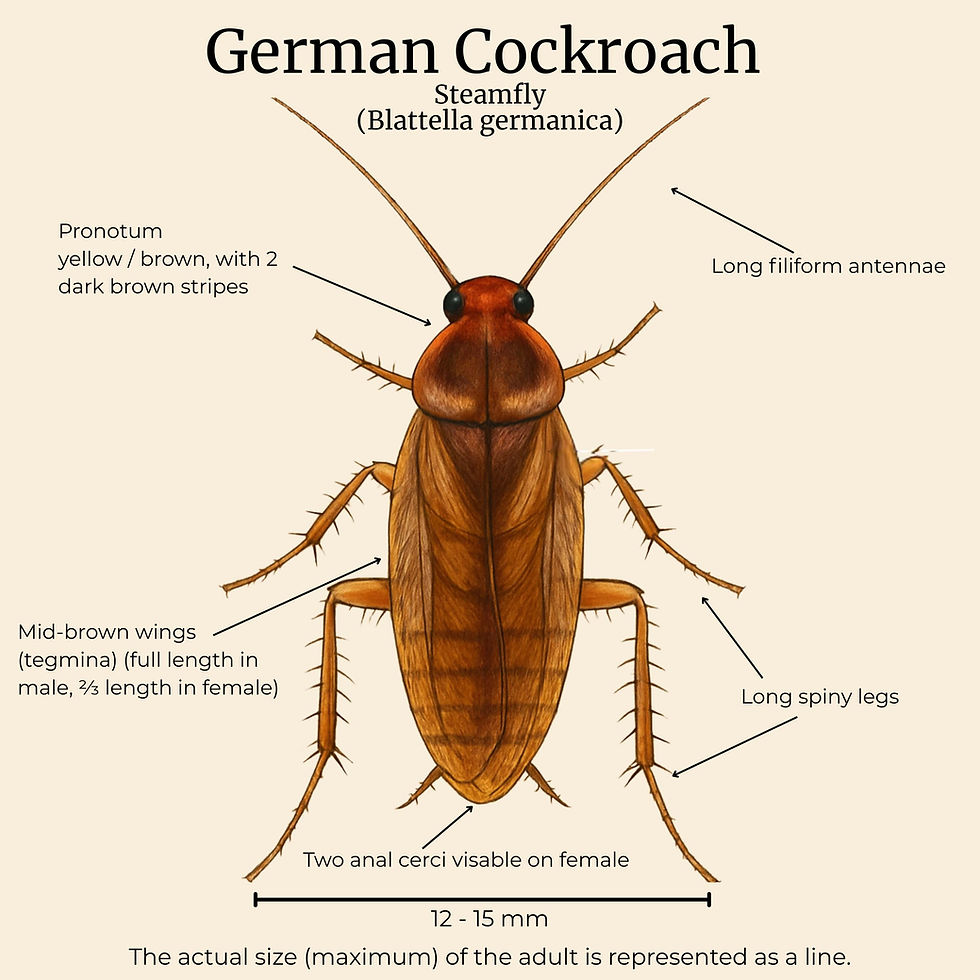
German cockroaches are relatively small, light brown to tan cockroaches with two dark longitudinal stripes behind the head.
They are particularly associated with warm, humid environments and are commonly found in kitchens, food preparation areas, commercial premises and around appliances and plumbing.
They reproduce quickly and can establish significant infestations if conditions are favourable. Read our guide to German cockroach identification →
Oriental Cockroach

Oriental cockroaches are generally larger and darker, often appearing black or very dark brown with a shiny appearance. They favour cooler, damp environments and can be associated with drains, basements, cellars, service areas and other sheltered locations.
Their behaviour and preferred harbourages differ from German cockroaches, which is one reason correct identification matters when planning treatment.
What If You Are Not Sure What You Have Seen?
Cockroaches can sometimes be mistaken for other insects, particularly beetles. Look for additional evidence such as droppings, shed skins, egg cases and nymphs, as these can help confirm whether cockroach activity is present.
If you have seen a cockroach but are unsure of the species or whether there is an established infestation, a professional inspection can help determine what is happening and where activity is concentrated.
The first step towards getting rid of cockroaches is knowing what you are dealing with.
Step 2: Confirm the Cockroach Infestation
Seeing a cockroach is a strong reason to investigate further, but the insect you see may only be a small indication of a much larger hidden problem. Cockroaches are predominantly nocturnal and spend much of the day concealed within suitable harbourages, making established infestations difficult to assess from sightings alone.
Look for other evidence of cockroach activity, particularly in warm, dark or sheltered areas.
Common Signs of Cockroach Activity
Signs can include:
Live cockroaches, particularly when found repeatedly or in different areas of the property
Cockroach nymphs, which can indicate an established breeding population
Droppings, often appearing as small dark specks or smears around harbourage areas
Egg cases (oothecae) attached to surfaces or concealed within cracks and sheltered locations
Shed skins, left behind as cockroaches develop through their nymph stages
Dead cockroaches or body parts
A persistent musty or unpleasant odour, particularly where infestations are established
Smear marks, which may appear around frequently used routes and harbourages
Pay particular attention to areas around sinks, plumbing, appliances, cupboards, kickboards, drains and other concealed spaces where cockroaches may find warmth, moisture and protection.
Does Seeing One Cockroach Mean You Have an Infestation?
Not necessarily, but it should never be ignored. A single cockroach may have entered from outside, arrived in packaging or migrated from another part of a building. However, because cockroaches are secretive and reproduce rapidly under favourable conditions, a sighting can also indicate hidden activity.
The presence of nymphs, egg cases, droppings or repeated sightings provides stronger evidence that cockroaches are established and reproducing within or around the property.
Where activity is suspected, identifying the source and extent of the infestation is more useful than simply counting the cockroaches you can see.
Look Beyond the Places Where You See Cockroaches
Cockroaches do not necessarily remain close to the location where they are spotted. They can move through gaps, cracks, service voids, pipe routes and other concealed areas in search of food, water and suitable harbourage.
For this reason, effective control starts with determining where the cockroaches are hiding and how they are moving through the property.
For more detailed information, see our guide to the 5 early warning signs of cockroaches.
Once an infestation has been confirmed, the next step is to locate the harbourages and conditions allowing the cockroaches to survive.
Step 3: Find Where Cockroaches Are Hiding
Finding where cockroaches are harbouring is a critical part of effective control. Cockroaches rarely remain exposed for long. During daylight hours they typically retreat into dark, sheltered locations where they can remain protected while still having access to food, moisture and suitable temperatures.
The places they choose will depend on the species and the conditions within the property.
Common Cockroach Harbourages
Cockroaches can establish harbourages in surprisingly small gaps and concealed spaces, including:
Behind and underneath kitchen appliances
Behind refrigerators, freezers, cookers and dishwashers
Inside kitchen units and cupboards
Beneath sinks and around plumbing
Behind kickboards and fitted units
Around pipes and service penetrations
Inside cracks and crevices
Within wall and floor voids
Around boilers, heating systems and warm pipework
Near drains and drainage infrastructure
In basements, cellars and other damp areas
Around electrical equipment and other sources of warmth
Within cluttered storage areas
Around food preparation and waste areas
Cockroaches can also move between rooms through concealed routes. In flats, HMOs and other shared buildings, they may travel through service ducts, pipework routes, wall voids and other interconnected areas.
Look for the Conditions Cockroaches Need
Finding a cockroach harbourage is not simply about looking for insects. You should also look for the environmental conditions that make an area suitable for them.
Cockroaches are attracted to combinations of:
Food: crumbs, grease, food residue, waste and poorly stored food can provide accessible sources of nutrition.
Water: leaking pipes, dripping taps, condensation and damp areas can provide the moisture cockroaches need.
Warmth: some species, particularly German cockroaches, favour warm areas around appliances, boilers, pipework and other heat sources.
Shelter: cracks, gaps, voids, clutter and concealed spaces provide protection from disturbance and allow cockroaches to remain hidden.
Where these conditions occur together, an area can become an ideal cockroach harbourage.
Don't Assume the Kitchen Is the Only Problem Area
Kitchens are common locations for cockroach activity because they can provide food, water and warmth, but an infestation should not automatically be considered a kitchen-only problem.
Cockroaches may move through adjoining rooms, service voids, drainage routes and structural gaps. In commercial premises, activity may also extend into storage areas, plant rooms, waste areas and other parts of the building.
This is why treating only the location where a cockroach was seen can fail to address the wider infestation.
Finding the Source Matters
The objective is not simply to find where cockroaches are visible. Effective control requires identifying where they are harbouring, how they are accessing the property and what conditions are allowing them to survive.
Once these factors are understood, treatment can be targeted towards the areas of greatest activity rather than relying on indiscriminate spraying.
The next step is to remove or reduce the food, water and environmental conditions that are helping the infestation survive.
Step 4: Remove Food, Water and Harbourage Conditions
Once you have identified the areas where cockroaches are active, the next step is to remove or reduce the conditions that allow them to survive. Cockroaches need access to food, water and suitable shelter. Good housekeeping can make a property less favourable to cockroaches and can significantly support professional treatment, but cleaning alone will not normally eliminate an established infestation.
Remove Accessible Food Sources
Cockroaches are opportunistic feeders and can exploit very small amounts of food residue.
To reduce available food:
Keep food in sealed containers rather than open packaging.
Clean up crumbs and food spills promptly.
Clean grease and food residue from worktops, floors and cooking areas.
Empty food waste regularly and keep bins closed.
Avoid leaving pet food available overnight.
Clean underneath and behind kitchen appliances where food debris can accumulate.
Keep food preparation and storage areas clean.
Remove unnecessary cardboard and food packaging where it may provide shelter or retain food residue.
Pay particular attention to areas that are difficult to clean routinely, as these can provide both food and shelter.

Remove Sources of Water and Moisture
Water can be just as important as food when cockroaches are establishing themselves in a property.
Check for:
Leaking taps
Leaking pipes and joints
Drips beneath sinks
Condensation around appliances and pipework
Standing water
Damp areas
Water collecting around drains
Poorly ventilated areas
Repair leaks where possible and keep sinks and surrounding surfaces dry when they are not in use. Reducing moisture is particularly important where cockroaches are using areas around plumbing, drainage or other damp harbourages.
Reduce Clutter and Suitable Harbourage
Cockroaches need somewhere to remain concealed. Excess clutter can provide additional harbourage and make inspection and treatment more difficult.
Where practical:
Remove unnecessary clutter from affected areas.
Avoid storing large quantities of cardboard in infested areas.
Keep storage areas organised and accessible.
Avoid allowing items to accumulate around appliances, cupboards and other potential harbourages.
Maintain access to areas that may need to be inspected or treated.
This does not mean that every item in an affected room needs to be removed. The objective is to reduce unnecessary shelter and make potential harbourages easier to identify and treat.
Good Hygiene Supports Treatment — It Does Not Replace It
Improving hygiene and housekeeping is an important part of cockroach management, but it is a mistake to assume that an infestation is simply caused by an unclean property.
Cockroaches can establish infestations in clean homes, restaurants, offices and other well-maintained premises if they have access to suitable harbourage, moisture, warmth or food.
Likewise, a property can be thoroughly cleaned while cockroaches remain hidden inside wall voids, behind appliances, around plumbing or in other inaccessible areas.
The aim is to remove the resources supporting the infestation while ensuring the cockroaches themselves are properly controlled.
Don't Disturb Potential Treatment Areas
If professional treatment is being carried out, follow the pest controller's preparation and aftercare instructions carefully. Moving appliances, washing treated areas or using additional household insecticides without advice can interfere with the treatment strategy.
Professional treatment should be coordinated with the environmental improvements being made within the property.
Once food, water and harbourage conditions have been addressed as far as reasonably possible, the next step is to prevent cockroaches from entering or moving through the property.
Step 5: Seal Entry Points and Prevent Cockroach Movement
Once potential harbourages and sources of activity have been identified, the next consideration is how cockroaches are gaining access to, or moving through, the property.
Cockroaches can exploit small gaps and concealed routes within buildings. Depending on the species and property, these may include gaps around utility services, plumbing penetrations, doors, wall cavities, service ducts and other structural openings.
However, proofing is not always carried out at the same stage of every cockroach treatment. A professional inspection should establish whether sealing an access route immediately is appropriate or whether treatment should take place first. The correct approach depends on the building, the location of the infestation and how the cockroaches are using the available harbourages and routes.
Common Access and Movement Routes
Potential routes should be checked around:
Gaps around pipes and plumbing
Openings around cables and other utility services
Cracks and gaps in walls, floors and skirting
Gaps behind fitted kitchen units
Gaps beneath or around doors
Damaged seals and defective building fabric
Service penetrations and ducts
Wall and floor voids
Areas where adjoining properties or communal spaces connect
Drainage and plumbing infrastructure where appropriate
Where suitable, unnecessary gaps and structural defects should be repaired using appropriate materials such as suitable fillers, sealants or other permanent repairs.
Cockroaches Can Move Through Buildings
Not every route used by cockroaches is an external entry point. Once inside a building, they can move between rooms and harbourages through cracks, voids, service routes and gaps around pipes and other utilities.
This is particularly important in flats, HMOs, terraced properties and commercial premises, where adjoining areas may be interconnected.
Treating only the room where a cockroach has been seen may therefore leave other harbourages or movement routes untouched.
Don't Ignore Deliveries and Packaging
Cockroaches can also be introduced into a property rather than entering through the building fabric. Food deliveries, packaging, cardboard, second-hand appliances and other items can provide opportunities for cockroaches or egg cases to be transported into a building.
For businesses, incoming goods and deliveries should therefore form part of routine pest awareness and inspection procedures.
Drains and Plumbing
Plumbing and drainage areas can provide moisture, shelter and concealed routes. Oriental cockroaches in particular can sometimes be associated with drainage systems and may be traced back to sewers in some circumstances.
However, drainage should not be altered or sealed indiscriminately.
If drainage is suspected as a source or route of cockroach activity, it should be properly assessed so that any remedial work addresses the underlying problem without creating additional issues.
Proofing Is Part of Long-Term Cockroach Control
Proofing helps reduce opportunities for cockroaches to enter a property or move between areas, but it does not eliminate an established infestation on its own.
If cockroaches are already harbouring inside a building, sealing visible gaps without addressing the infestation can leave the existing population untouched. In some situations, premature proofing can also affect how cockroaches move between harbourages and may make treatment more difficult.
For this reason, the timing and extent of proofing should form part of an overall pest management strategy rather than being treated as a standalone solution.
Effective cockroach control combines appropriate treatment with environmental management, structural repairs and proofing where required.
Once the source, harbourages and movement routes have been assessed, the next step is to determine whether DIY measures are appropriate or whether professional cockroach treatment is required.
Step 6: Decide Whether DIY Cockroach Treatment Is Enough
If you have identified cockroach activity, it is understandable to consider treating the problem yourself. Some products are available for amateur use, and minor infestations may sometimes be managed with appropriate products when they are used correctly.
However, cockroach control can be difficult because the insects hide in inaccessible harbourages, reproduce quickly and may remain concealed even when visible activity appears to have reduced. For an established, persistent or widespread infestation, professional pest control is usually the more reliable option.
What Can You Do Yourself?
Before considering insecticide treatment, concentrate on the environmental measures already covered in this guide:
Remove accessible food and food residue.
Keep food stored securely.
Remove food waste regularly.
Clean beneath and behind appliances.
Eliminate accessible sources of water and repair leaks.
Reduce unnecessary clutter and potential harbourage.
Check incoming packaging and second-hand appliances for signs of cockroach activity.
Seal suitable gaps and defects where appropriate.
These measures can make the property less favourable to cockroaches and support any subsequent treatment.
Are Sticky Traps a Treatment for Cockroaches?
Sticky monitoring traps can be useful for detecting and monitoring cockroach activity, but they should not be regarded as a method of eliminating an infestation.
They can help identify where cockroaches are active and provide useful information about the extent and direction of activity. BPCA recommends their use for monitoring rather than as a standalone control measure.
What About Cockroach Sprays and Insecticides?
Amateur insecticide products are available, but choosing and applying them correctly is important. Always check that a product is authorised for the intended use, follow the label instructions and never use a product intended only for professional users. The Health and Safety Executive (HSE) specifically advises members of the public not to use biocidal products that are restricted to professional users.
It is also important to understand that killing exposed cockroaches does not necessarily deal with those hidden within cracks, voids, appliances or other harbourages.
Success of insecticidal treatment depends on the products selected and how thoroughly they are applied, with particular attention needed around cracks and crevices where cockroaches, eggs and nymphs may be found.
When Should You Call a Professional?
Professional help should be considered if:
You continue to see cockroaches after taking preventative measures.
You are seeing cockroaches regularly or in multiple areas.
You have found nymphs or egg cases.
Cockroach activity is increasing.
The source of the infestation cannot be identified.
Cockroaches are present in difficult-to-access areas.
You live in a flat, HMO or other connected property where cockroaches may be moving between areas.
You operate a food business or other commercial premises where pest activity presents additional hygiene and operational concerns.
For established infestations, a professional pest controller can assess the property systematically, identify harbourages and determine the most appropriate treatment strategy rather than relying on a single product or method. BPCA recommends using a professional pest management company for cockroach infestations.
Why DIY Treatment Can Fail
The biggest problem with DIY cockroach control is often not the product itself, but what the treatment fails to reach.
Cockroaches may remain hidden in inaccessible harbourages, while egg cases and developing nymphs can contribute to continuing activity after the initial treatment. A reduction in visible cockroaches therefore does not necessarily mean the infestation has been eliminated.
Professional control takes a more systematic approach, combining inspection, identification, targeted treatment and monitoring. Depending on the circumstances, follow-up treatment may also be necessary.
If cockroaches are established, the objective should be complete control of the infestation rather than simply reducing the number of insects you can see.
The next step is to understand how professional cockroach treatment works and what you can expect from a properly managed infestation.
Step 7: Professional Cockroach Treatment
When cockroaches have become established, professional pest control provides a systematic approach to identifying, treating and monitoring the infestation. The objective is not simply to kill the cockroaches that are visible, but to locate the infestation, target the areas where cockroaches are harbouring and reduce the conditions that allow them to survive.
A professional cockroach treatment begins with an inspection to identify the cockroach species, locate harbourages and assess the extent of activity. The treatment can then be focused on the areas where cockroaches are most likely to be hiding.
Depending on the property and infestation, treatment may involve targeted cockroach baiting and other appropriate professional control methods. The aim is to reach the hidden population rather than simply killing the cockroaches that are visible.
Why Follow-Up Matters
Cockroach control is not always a one-visit process. Follow-up inspections and monitoring may be required to assess activity and determine whether further treatment is necessary.
This is particularly important where cockroaches have established harbourages or where different life stages are present.
Professional cockroach control therefore focuses on the source of the infestation, not just the symptoms.
At PGM Pest Control, we assess each infestation individually and use an Integrated Pest Management approach where appropriate, combining targeted treatment with practical advice on hygiene, harbourage reduction and prevention.
The result we are working towards is not simply fewer cockroaches — it is bringing the infestation under control and reducing the risk of it returning.
How Long Does It Take to Get Rid of Cockroaches?
The time required to get a cockroach infestation under control varies from one property to another. It depends on the cockroach species, the size and extent of the infestation, available harbourages and how easily those areas can be accessed and treated.
You may notice a reduction in activity following treatment, but seeing fewer cockroaches does not necessarily mean the infestation has been completely eliminated. Hidden cockroaches and developing nymphs can mean that monitoring and follow-up treatment are needed.
Following your pest controller's advice, maintaining good hygiene and addressing sources of food, water and harbourage will all help the treatment achieve the best possible result.
For this reason, professional cockroach control should focus on bringing the infestation under control and preventing further activity, rather than promising that every cockroach will disappear within a fixed number of hours or days.
Why Am I Still Seeing Cockroaches After Treatment?
Seeing a cockroach after treatment does not necessarily mean the treatment has failed. Cockroaches spend much of their time hidden within harbourages, and treatment can disturb their normal behaviour. You may therefore notice some activity as cockroaches emerge from areas that have been treated or disturbed.
An infestation can also contain different life stages, including eggs, nymphs and adults. This means that newly emerging cockroaches may be seen after the initial treatment, which is one reason monitoring and follow-up treatment can be an important part of effective control.
The important thing is to look at the overall level of activity, rather than judging the success of treatment based on a single sighting.
If cockroach activity continues, becomes more frequent or appears in new areas, contact your pest controller. Further inspection or treatment may be required to identify and deal with any remaining activity.
Do not apply additional insecticides or disturb professional treatment areas unless advised to do so, as this could interfere with the treatment strategy.
Effective cockroach control is about reducing and ultimately eliminating the infestation, while addressing the conditions that allowed it to establish in the first place.
How to Prevent Cockroaches from Coming Back
Once cockroach activity has been brought under control, prevention is the best way to reduce the risk of another infestation.
Keep food securely stored, clean food and grease residues promptly, manage waste properly and address leaks or sources of moisture. Reduce unnecessary clutter and maintain suitable proofing around gaps, service penetrations and other potential access points.
For businesses and properties at greater risk, ongoing monitoring and a planned pest management programme can provide additional protection against recurring activity.
If cockroaches continue to appear, don't simply treat each sighting as an isolated problem. Continuing activity may indicate that hidden harbourages, access routes or environmental conditions still need to be addressed.
When to Call PGM Pest Control
Cockroaches can be difficult to eliminate because much of an infestation can remain hidden from view. If you are seeing repeated activity, finding nymphs or egg cases, or have tried DIY treatment without resolving the problem, professional inspection can help establish what is happening and what needs to be done.
PGM Pest Control provides professional cockroach control for homes and businesses across Herefordshire and Worcestershire. Our experienced team assesses each infestation individually and focuses on targeted treatment, monitoring and practical prevention advice.
If you are concerned about cockroaches, don't wait for the infestation to become established.
Contact PGM Pest Control for expert advice and a tailored approach to getting your cockroach problem under control.
About PGM Pest Control
PGM Pest Control is an award-winning, family-run pest control company providing professional pest management for domestic and commercial customers throughout Herefordshire and Worcestershire.
Our qualified team takes a practical, responsible approach to pest control, combining professional treatment with prevention and Integrated Pest Management where appropriate.
From a single suspected cockroach to an established commercial infestation, we can assess the problem, identify the risks and recommend the most appropriate course of action.
For expert cockroach control and advice, contact PGM Pest Control on 01981 540088.