The Bed Bug Lifecycle Explained

Updated: Sep 25
Table of Contents
Bed bugs develop through a simple lifecycle: egg → nymph → adult. Understanding each stage is important because an infestation may contain bed bugs of different ages at the same time, which can affect how treatment and follow-up are managed.
Our BPCA-accredited technicians regularly inspect and treat bed bug infestations across homes, hotels and HMOs throughout Herefordshire and Worcestershire.
Stage 1: Bed bug eggs
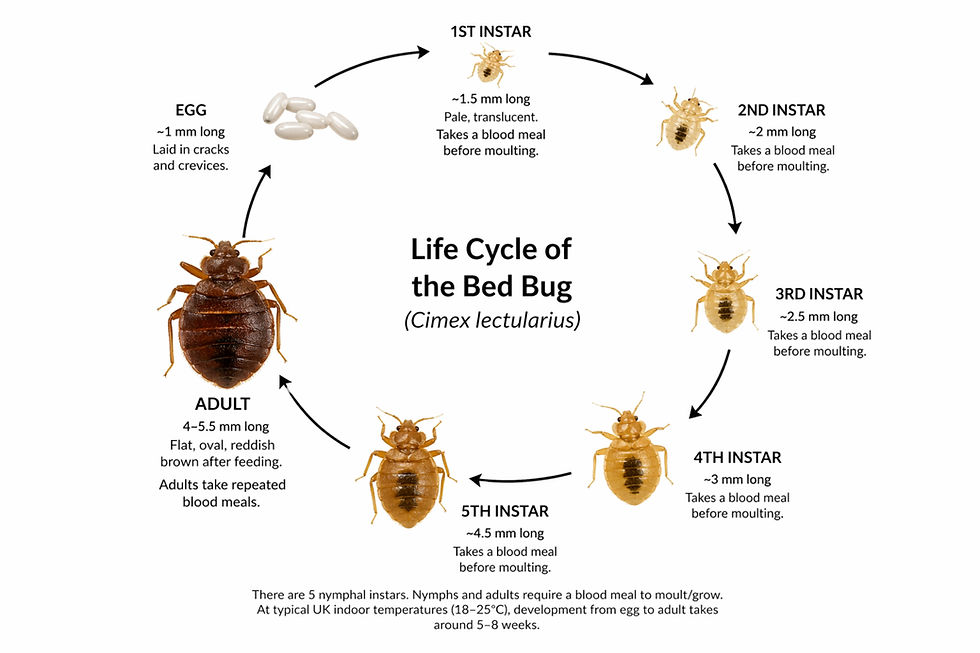
Bed bug eggs are very small, usually around 1 mm long, and are pearly white to off-white in colour.
They are often laid in protected harbourage areas such as:
Bed frame joints
Mattress seams
Furniture cracks
Headboards
Skirting and other narrow gaps
Because of their size and colour, eggs can be difficult to spot without close inspection.
Stage 2: Bed bug nymphs
After hatching, young bed bugs are known as nymphs.
Nymphs are smaller and paler than adults and pass through several developmental stages before reaching maturity.
As they grow, they:
Feed on blood
Moult between stages
Become larger
Become darker in colour
Freshly hatched nymphs can be particularly difficult to see because they are small and almost translucent when unfed.
Stage 3: Adult bed bugs
Adult bed bugs are usually around 4–7 mm long, with a flat, oval body and reddish-brown colouring.
Once mature, they continue feeding and reproducing, allowing an infestation to grow if left untreated.
How long does the bed bug lifecycle take?
The exact timing depends on temperature, access to a host and other environmental conditions.
In suitable conditions, bed bugs can develop from egg to adult in a matter of weeks, although development may take longer if feeding opportunities are limited.
This is one reason infestations can increase gradually before becoming obvious.
Why does the lifecycle matter for treatment?
An infestation may contain:
Eggs
Young nymphs
Older nymphs
Adults
Different life stages can be hidden in separate harbourage areas, and eggs may remain present after initial treatment.
For this reason, bed bug control often involves:
Thorough inspection
Targeted treatment
Monitoring
Follow-up treatment where required
Can bed bugs survive without feeding?
Yes.
Bed bugs can survive for extended periods without feeding, particularly in cooler conditions. This means an empty room does not necessarily mean an infestation has disappeared.
Why follow-up may be needed
Bed bug infestations can be persistent because insects may be hidden deep inside cracks, furniture and other harbourage areas.
Follow-up helps confirm whether:
Newly hatched nymphs are present
Activity has continued
Further treatment is required
Think you may have bed bugs?
If you suspect bed bug activity, our BPCA-accredited team can inspect the property, identify the extent of the infestation and recommend the most appropriate treatment plan.