Herefordshire Residents Advised to Prepare for Increased Wasp Activity This Summer

Updated: Jun 6
Key takeaway
A mild winter means more queen wasps may have survived into spring, increasing the likelihood of nest activity this summer. PGM Pest Control are already seeing above average wasp nest removal call-outs, the early signs of what could be a particularly active wasp season in Herefordshire.
Watch for: ✔ Regular wasp flight paths ✔ Activity around rooflines ✔ Nests in sheds, lofts, garages and commercial premises.
Listen on BBC Radio Hereford & Worcester
As we move into June, the award-winning team at PGM Pest Control — Herefordshire's most trusted BPCA-accredited pest control specialists — are advising both homeowners and businesses across the county to stay vigilant for signs of wasp activity.
Nests are developing rapidly right now, and early identification is always the key to easier, safer management
Wasp season is well underway. Queen wasps emerged from hibernation earlier in the spring to establish new colonies in lofts, sheds, garages, wall cavities, roof spaces and commercial outbuildings.
During June, the first generation of worker wasps becomes active, and colonies begin to expand quickly.
What Does 2026's Wasp Season Look Like for Herefordshire?
Current observations across the UK pest control sector suggest that 2026 could see higher-than-average wasp activity. A mild winter is likely to have improved queen survival rates, meaning more nests are forming this spring and early summer than in a typical year.
For Herefordshire properties — particularly those with roof voids, outbuildings, barns, orchards and agricultural land — the conditions this season are especially favourable for nest establishment.
Wasp, Hornet or Bee? Don't Make a Costly Mistake
One of the most common calls we receive is from residents and business owners who aren't quite sure what they're dealing with. Correct identification matters — because the approach to treatment is very different.
Wasps are the most commonly encountered
They have a distinctive narrow waist, smooth body and bright, well-defined yellow and black banding. Unlike bees, a wasp can sting repeatedly without losing its stinger, making a disturbed colony particularly dangerous.
Hornets — specifically the European Hornet
Hornets are larger than common wasps, with brown and yellow colouring rather than the classic black and yellow. They tend to be less aggressive than wasps when left undisturbed, but their size and venom make stings more severe.
The Asian Hornet is an invasive species now occasionally reported in parts of the UK and should be reported to the Non-Native Species Secretariat rather than treated independently. Think you've seen an Asian hornet? Report it here >
Bees are generally rounder, fluffier and less aggressive than wasps
Honeybees and bumblebees are enormously valuable to the environment — they should never be treated with pesticides. If you suspect you have a honey bee swarm or colony, contact Herefordshire beekeeper's to collect the swarm, rather than a pest controller.

If you're unsure what you're dealing with, don't guess and don't disturb it. Contact PGM Pest Control and we'll help you identify it correctly before any action is taken. The difference between bees, wasps, and hornets >
What to Expect Over the Coming Months |
June — Early Nest GrowthWorker wasps begin emerging and nest activity becomes increasingly noticeable. Homeowners and business owners may start to spot regular flight paths to and from rooflines, soffits, air bricks and outbuildings. This is the ideal time to act — nests are still small and far more manageable at this stage. |
July — Peak Nest DevelopmentColonies grow significantly in size. Wasp numbers increase around homes, gardens, business premises, hospitality venues and retail spaces. For food businesses and those with outdoor customer areas, this is the time to have a professional plan in place. |
August to September — Highest Nuisance PeriodThis is typically when wasps become most disruptive — and most aggressive. As natural food sources decline, worker wasps are drawn to sugary foods and drinks, outdoor dining areas, waste bins and fallen fruit. For both residential and commercial properties, the risk of stings and customer disruption is at its highest. |
October — Colony DeclineAs temperatures fall, colonies naturally die off and nest activity decreases. Only newly mated queens survive the winter, ready to start the cycle again next spring. Why am I still seeing wasps in October? > |
Why Are Wasps So Aggressive in Late Summer?
Many people notice that wasps seem far more bad-tempered in August and September than they do earlier in the year — and there's a clear biological reason for it.
Throughout spring and early summer, worker wasps have a clear purpose: feeding larvae back at the nest. The developing grubs produce a sugary secretion that the workers feed on in return, keeping the colony functioning in an orderly way.
By late summer, the queen stops laying eggs. The larvae are gone, the secretion dries up, and worker wasps are left with no role and no reliable food source. They become increasingly restless, hungry and prone to defensive behaviour — particularly around anything sweet.
This is why wasps in August seem to descend on every cold drink and piece of fruit, and why even minor disturbances near a nest at this time of year can trigger an aggressive response.
Understanding this seasonal shift is another reason why early action — before the colony reaches this stage — is always the better approach.
Why Herefordshire Properties Are Particularly Vulnerable
Herefordshire's unique mix of rural homes, farms, orchards, older buildings and extensive countryside creates ideal nesting conditions for wasps and hornets.
Properties with loft voids, barns, outbuildings and roof cavities are especially attractive targets during the warmer months.
For commercial businesses — particularly those in hospitality, food retail, leisure and agriculture — a wasp nest on or near the premises isn't just an inconvenience. It's a health and safety risk that needs prompt, professional attention.
The message is straightforward: if you operate a food business in Herefordshire and you have wasp activity on your premises, act immediately.
Does the Council Treat Wasp Nests?
This is one of the most frequently asked questions we hear, particularly from homeowners looking to manage costs. Herefordshire Council does not provide a wasp nest removal service for domestic properties. Their environmental health and pest control teams deal strictly with commercial and business premises only.
For Herefordshire residents and businesses looking for a reliable, prompt response with guaranteed results, PGM Pest Control offer a professional wasp nest removal service with fully certified RSPH technicians, comprehensive aftercare advice and the reassurance of BPCA accreditation.
During the busiest months, waiting for a council appointment could mean a nest of several thousand wasps rather than a few hundred.
Under current UK industry regulations, professional-grade treatments are restricted to certified pest control technicians in order to limit environmental impact
If you suspect a nest on your property or premises, always seek qualified professional advice before attempting any treatment yourself.
Know the Signs of a Wasp Nest

Whether you're a homeowner or managing a business premises, it pays to know what to look for:
Regular wasp traffic entering and leaving the same point on a building
Increased activity around rooflines, soffits and air bricks
Wasps entering sheds, garages, loft spaces or outbuildings
A visible papery nest structure
Persistent wasp activity concentrated in one specific area
What Does a Professional Wasp Treatment Actually Involve?
We know that for many people, calling in a pest controller raises a simple question: what actually happens? Here's exactly what to expect when you call PGM Pest Control.
1. Initial Assessment
When our pest technician arrives, the first step is to locate and assess the nest — its position, size and accessibility. This allows us to determine the safest and most effective treatment approach.
2. Treatment Application
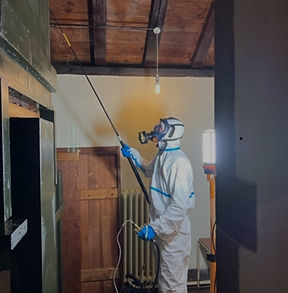
Our technicians apply a professional-grade insecticidal dust or spray directly into or around the nest entrance. This insecticide can be harmful to pets and fish and must not be inhaled, which is why professional application is essential. The product is applied using specialist equipment, with our technicians wearing full protective clothing throughout.
3. Immediate After-Treatment Activity
Following treatment, wasps will temporarily become more active as they attempt to defend the nest. It is advisable to keep windows and doors closed until activity subsides — this is usually within 24 hours.
4. Nest Clearance
Once the colony has been eliminated, the nest itself can be left in place in most cases — wasps don't return to old nests, so removal is not always necessary (and is an added cost) unless it is causing a structural or cosmetic issue. We will advise you on the best course of action.
5. Aftercare and Re-Treatment Guarantee
If a nest remains active after treatment, we will return to re-treat at no additional charge. We also provide practical advice on reducing the likelihood of future nest establishment on your property. The entire process is straightforward, safe and — crucially — far less disruptive than attempting to manage an active nest yourself.
Expert Advice from PGM's BPCA-Certified Technicians
"At this stage of the season, we're seeing nests become increasingly active as worker wasps emerge and colonies expand. Identifying a nest early is far easier — and considerably less costly — than dealing with a fully developed colony later in the summer.
We would always advise homeowners and business operators not to attempt to treat active nests themselves. Disturbing a nest can provoke defensive behaviour and significantly increase the risk of stings to you, your family, your staff or your customers."
Early Action Always Pays Off
A nest identified in June is significantly easier and safer to treat than one discovered in August, when colonies can contain thousands of highly defensive worker wasps.
The sooner you act, the simpler and more straightforward the solution
Under current industry regulations, professional-grade treatments are restricted to certified pest control technicians in order to limit environmental impact. If you suspect a nest on your property or premises, always seek qualified professional advice before attempting any treatment yourself.
How to Prepare and Manage Wasp Nests This Summer
Minimise attractants | Keep bins tightly sealed, clear away food and sugary debris promptly, and manage fallen fruit in gardens and orchards. |
Check vulnerable areas early | Inspect loft spaces, eaves, sheds and outbuildings regularly throughout June and July. |
Act at the first sign | Don't wait for a nest to grow. Early intervention prevents a colony of up to 5,000 workers from forming later in the season. |
PGM Pest Control offer expert wasp nest identification, treatment and prevention advice for both residential and commercial clients across Herefordshire. |
For expert wasp nest treatment and prevention advice, contact PGM Pest Control — Herefordshire's largest and most trusted BPCA-accredited pest control specialists on 01981 540088 or email contact@pgmpestcontrol.co.uk
Have you noticed more wasps and house flies around lately?
This week on What the Fact?, a listener asked Elliott Webb whether insect numbers are higher than usual this summer.
Phil Martin from PGM Pest Control Services joins the programme to explain what's driving the increase and what it could mean for homeowners and businesses.